
Buyers currently have more negotiating power than they’ve had in years, and the smartest way to use that leverage isn’t guesswork, it’s data. Here’s a real look at how that plays out, using a recent client situation and the exact kind of market analysis I build before any offer gets written.
The Situation
I have a couple who paused their home search for the better part of a year while they got things in order. Three weeks ago, they picked it back up. In the past 21 days, they’ve seen 19 homes. And of course, the one they fell for is priced above where they’d originally hoped to land.
It would have been easy to assume that meant the home was off the table. Instead, we slowed down and looked at the actual numbers.
Why I Don’t Guess
Before any of my clients write an offer, I pull recent comparable sales in the area: what similar homes have truly sold for, how many days they sat on market, and what concessions buyers on those deals actually received. That last piece matters more than a lot of people realize right now.
In a market where buyers have real leverage, sellers are often more open to covering closing costs or buying down a rate than dropping the price outright. Knowing what’s typical in a given area turns a hopeful offer into a strategic one.
A Sample of the Actual Tool
Below is a sample version of the market analysis report I build for buyers, using a placeholder property so you can see the format without it being tied to any real client’s home.
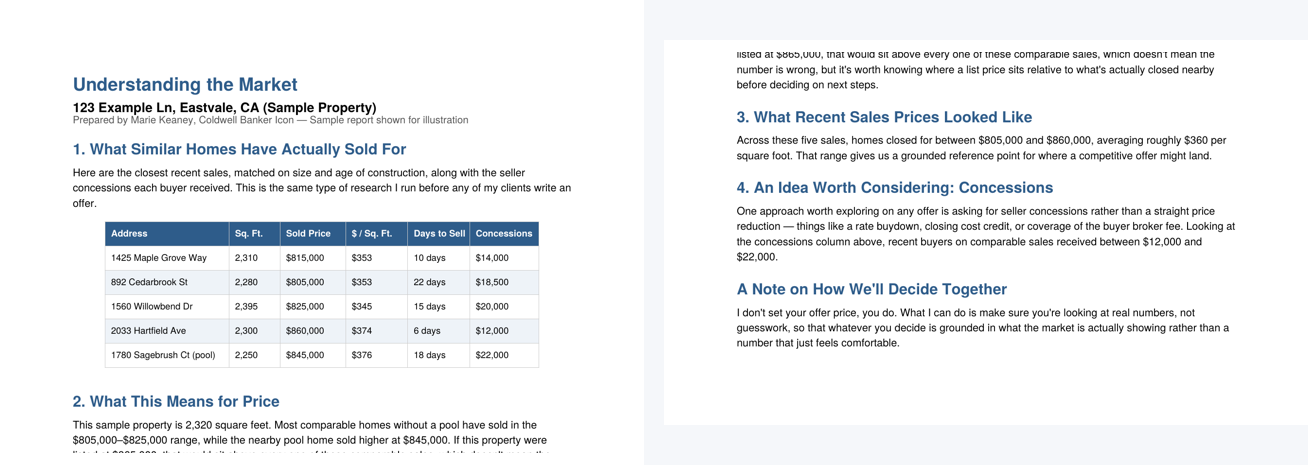
The report breaks down into four parts: what comparable homes have actually sold for, what that means for the price of the home in question, what recent sale prices looked like as a range, and whether seller concessions are worth exploring as part of a future offer.
How I See My Role in This
I don’t set a client’s offer price, they do. What I can do is make sure they’re looking at real numbers, not guesswork, so that whatever they decide is grounded in what the market is actually showing rather than a number that just feels comfortable.
That’s the difference between hoping an offer works and knowing why it should.
Want This for a Home You’re Watching?
If you’re curious what a similar analysis would look like for a specific home, in Eastvale, Ontario Ranch, Jurupa Valley, or anywhere in the Inland Empire, I’m happy to put one together for you. No pressure, just information.
FAQs
What does buyer leverage mean in real estate?
Buyer leverage means buyers have more negotiating power than sellers, often because homes are sitting longer or inventory is higher. It typically shows up as sellers being more willing to offer concessions, credits, or price flexibility.
What are seller concessions?
Seller concessions are costs a seller agrees to cover for the buyer, such as closing costs, a rate buydown, or a buyer broker fee.
Why would a seller offer concessions instead of a lower price?
Concessions can help a buyer more directly, like lowering their monthly payment through a rate buydown, while still letting the seller keep the sale price closer to their goal, which matters for comps in the neighborhood.
How do you figure out if a home is priced fairly?
Comparing the home to recent comparable sales nearby, factoring in size, condition, and days on market, gives a grounded read on where a fair offer price actually sits.