If you just moved to Eastvale, or you’re circling houses on Zillow at midnight, someone has probably already dropped the phrase “track schedule” on you like it was common knowledge. It’s not. Nobody hands you a decoder ring when you cross the city line, so let’s fix that.
Here’s the short version: almost every elementary school in Eastvale runs on a multi-track, year-round calendar instead of the traditional August-to-June schedule most of us grew up with. It’s not a quirky local tradition. It’s a direct result of how fast this city grew, and it still shapes which school your kid ends up at today, sometimes whether you like it or not.
Below is exactly how the Eastvale elementary calendar system works, which schools are multi-track, which ones aren’t, current enrollment for each, and why “overcrowded” keeps coming up every time this topic gets brought up at pickup.
What “Multi-Track” Actually Means
A traditional calendar puts every student on the same schedule. School starts in the fall, runs through June, and everyone gets summer off together. A multi-track, year-round calendar splits the student body into separate tracks, usually A, B, C, and D, that rotate through school and vacation periods on a staggered basis all year long. At any given time, three tracks are in session and one is off, so the building is never trying to hold every enrolled kid at once.
That’s the whole point, and I want to be blunt about it: multi-track scheduling is a capacity strategy, not an educational philosophy. A campus built to comfortably hold 800 kids under a traditional calendar can serve roughly 1,000 to 1,100 kids under a four-track rotation, because a quarter of the student body is always off site. Eastvale leaned on this model because the population exploded faster than new schools could get built, and the district is still leaning on it.
The tradeoff is real. Families on different tracks get different winter breaks, different spring breaks, and different summers, so neighbors and even siblings can be living on completely different school calendars depending on which track they land on.
The Traditional Exceptions: Clara Barton and VanderMolen
Here’s the detail almost nobody mentions until you’re already mid-enrollment: inside actual Eastvale city limits, Clara Barton Elementary School is the only elementary school running a traditional, single-track calendar. CNUSD has said this outright in its own facilities communications: with the exception of Barton, Eastvale’s elementary schools stay on year-round calendars.
But if you widen the lens to CNUSD schools that serve Eastvale families, not just what sits inside the city line, there’s a second traditional option: Louis VanderMolen Fundamental Elementary. VanderMolen sits just across the border in Jurupa Valley, but it’s CNUSD, it enrolls Eastvale kids, and it runs a traditional calendar, too.
If a standard August-to-June schedule matters to your family, because that’s what grandparents, travel sports, or summer camp all run on, Barton and VanderMolen are both worth understanding before you sign anything.
Eastvale Elementary Schools at a Glance
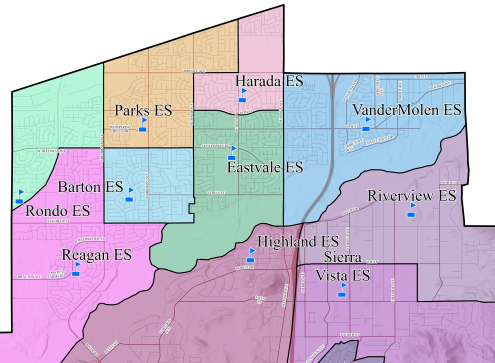
Here’s every CNUSD elementary school that serves Eastvale families, whether it sits inside the official city limits or just across the border, listed alphabetically, with its calendar type, most recently reported enrollment, and an honest read on overcrowding.
One thing I want to be straight with you about: California districts don’t publish a clean enrollment-versus-capacity percentage for every campus, so I can’t hand you an exact overcrowding number, and I’m not going to pretend I can. What I can tell you is documented: multi-track scheduling exists because these campuses need more room than a single-track calendar gives them, CNUSD has said flat out that one Eastvale school was built specifically to relieve overcrowding at two others, and at least one Eastvale campus has an actual sign posted out front telling families it’s full. Treat the table below as an honest read on real signals, not an official audit.
| School | Calendar | Enrollment | Overcrowded? |
|---|---|---|---|
| Clara Barton Elementary | Traditional | 1,079 | Not part of the multi-track relief system, and its enrollment already rivals the year-round campuses despite having no built-in overflow valve. |
| Eastvale Elementary | Multi-track (year-round) | 1,020 | Runs multi-track because a traditional calendar could not physically fit this many kids on one campus at once. |
| Harada Elementary | Multi-track (year-round) | 1,056 | Runs multi-track for the same reason as Eastvale Elementary: too many students for a single-track calendar to hold. |
| Philistine Rondo School of Discovery | Multi-track (year-round) | 1,206 | Built in 2020 specifically to pull overflow off Rosa Parks and Ronald Reagan, and it has already grown into the largest campus on this entire list. |
| Ronald Reagan Elementary | Multi-track (year-round) | 1,016 | One of the two schools Rondo was built to relieve. There is currently a sign posted at the front of the school stating it is over capacity and cannot accept additional students, so this isn’t a guess, it’s posted on the building. |
| Rosa Parks Elementary | Multi-track (year-round) | 970 | The other school Rondo was built to relieve. |
| Louis VanderMolen Fundamental Elementary | Traditional | 915 | Sits just across the Eastvale border in Jurupa Valley and runs on a traditional calendar with no multi-track relief valve, similar to Barton. |
Enrollment figures reflect the most recently published district and state data available for each campus, ranging from 2023-24 to 2025-26 depending on what each school last reported. VanderMolen is included here because it’s a CNUSD school that enrolls Eastvale students, even though it sits just across the city line in Jurupa Valley.
Why “My Kid Can’t Get Into the Closest School” Keeps Happening
If a neighbor has told you they couldn’t enroll their child at the elementary school nearest their own house, that’s not gossip. It’s a documented pattern, and it’s happened more than once.
When Ronald Reagan Elementary opened in 2015, CNUSD redrew attendance boundaries for Clara Barton, Harada, and Eastvale Elementary, shifting which streets fed into which school. When Rondo opened in 2020, the district built it specifically to pull enrollment pressure off Rosa Parks and Ronald Reagan, and boundary lines moved again. And if you want proof this isn’t theoretical, drive past Ronald Reagan Elementary. There’s a sign on the front of the school telling families it’s over capacity and can’t take more students. That’s not a rumor circulating in a Facebook group. That’s posted on the building.
Every time Eastvale adds a school, existing zones get rebalanced, and a house that used to feed into one school can suddenly feed into a different one entirely. CNUSD is currently running a district-wide Facilities Master Plan, gathering data on building capacity, enrollment trends, and community feedback to plan for what comes next. Translation: this isn’t finished. More boundary shuffling is a real possibility as Eastvale grows with the addition of Eastvale Square and the Shawood community.
What This Means If You’re House Hunting
School assignment in Eastvale isn’t just a parenting question. It’s a real estate question, and I’d be doing you a disservice if I pretended otherwise. Two homes on the same street can occasionally feed into different elementary schools depending on exactly where the boundary line falls, and that line has no obligation to stay put. If a specific school or calendar type matters to your family, confirm the assigned school for the exact parcel you’re considering before you write an offer, not after the moving truck leaves.
It’s a five-minute phone call. It can save you from an unpleasant surprise the following August. Or July. Or whichever month your track happens to kick off.
Frequently Asked Questions
Are all elementary schools in Eastvale year-round?
No. Inside actual city limits, five of the six elementary schools run on a multi-track, year-round calendar, and Clara Barton is the one exception. Once you include CNUSD schools just across the border that also serve Eastvale families, Louis VanderMolen Fundamental Elementary is a second traditional-calendar option.
Why do Eastvale schools use a multi-track calendar instead of a traditional one?
Multi-track scheduling lets a school building serve more students than it could hold on a traditional calendar, since only a portion of the student body is on campus at any given time. CNUSD leaned on this model in Eastvale specifically to keep pace with the city’s rapid growth.
Which Eastvale elementary school is traditional, not multi-track?
Clara Barton Elementary School is the only traditional-calendar elementary school inside Eastvale’s actual city limits. Louis VanderMolen Fundamental Elementary is also traditional and enrolls Eastvale students, but it sits just across the city line in Jurupa Valley.
Can I choose which track my child is placed on?
Track assignment is handled by each individual school and can depend on things like sibling placement and space available on a given track. Contact the specific school’s office directly for how they currently handle it.
Why can’t my child attend the elementary school closest to my house?
CNUSD draws attendance boundaries by geographic zone, not simple distance, and those zones shift whenever a new school opens or enrollment pressure forces a rebalance. Two nearby addresses can feed into different schools, and boundary lines can move over time.
Is overcrowding a real issue in Eastvale schools?
Yes, and it’s documented, not just a feeling people have. CNUSD has said Philistine Rondo School of Discovery was built specifically to relieve overcrowding at Rosa Parks and Ronald Reagan Elementary, Reagan currently has a sign posted at the school stating it’s over capacity and can’t accept more students, and the district is running a Facilities Master Plan process driven partly by enrollment and capacity data.
Is VanderMolen Elementary part of Eastvale?
Louis VanderMolen Fundamental Elementary is physically located just outside Eastvale’s city limits in Jurupa Valley, but it’s part of CNUSD and enrolls Eastvale students, which is why it’s included in the school list above. It runs a traditional, single-track calendar.
Where can I find the official attendance boundary for a specific address?
CNUSD publishes attendance boundary maps for each school on the district’s official website, and individual school offices can confirm which zone a specific address falls into.
Does school assignment affect home values in Eastvale?
It can. Buyers frequently prioritize a specific school or calendar type, which shapes demand for homes inside a given attendance zone. Confirming the assigned school before making an offer is a smart step for any family with school-age kids. There are currently several homes for sale near Clara Barton Elementary, and in Riverbend which feeds to VanderMolen.
Have questions about which Eastvale neighborhood feeds into which school, or how boundary changes could affect your home search? Reach out, and let’s talk it through.